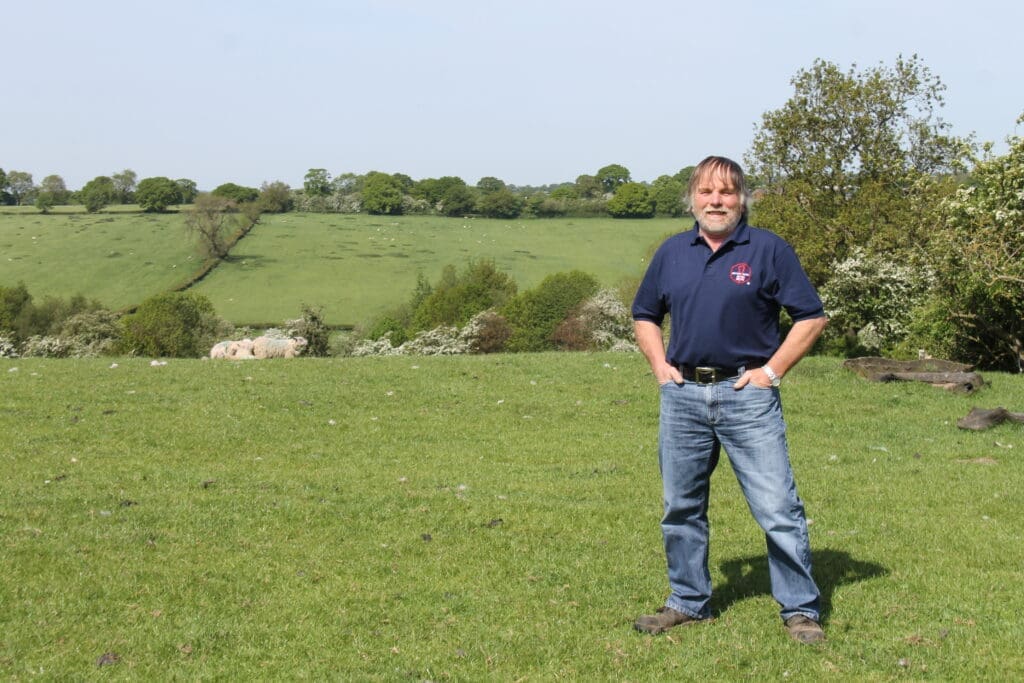
In this Q&A, we speak with Richard Spencer, our board member for English Central. His farming roots lie in the Midlands and whose career has been shaped by a lifelong commitment to sheep farming and the wool industry. From working directly on the farm to representing members at board level. Richard shares insights into his journey with us, the responsibilities of leadership. The importance of championing British wool as a natural, sustainable fibre. The discussion also explores current industry challenges, the value of farmer engagement, and what we represent for the future of the sector.
Can you tell us about your background in farming and the wool industry?
I started life farming on a mixed farm in the Midlands, and sheep have always been a big part of what we do. We also ran cattle for many years, but in 2009 we made the decision to sell the cows and focus our time and effort on sheep instead. Since then, sheep farming has really been at the heart of the business. Wool has always been a by-product I’ve had a strong interest in. Over the years, you get to understand how important wool is to the industry, not just as a product but as part of the whole sheep enterprise.
How did you first become involved with us, and what led to you becoming a board member?
I first got involved when I noticed there was no Derbyshire delegate on the Central Committee. It felt like a gap that needed filling. So I put my name forward, mainly to make sure local farmers had a voice. Much to my surprise, I was then elected Chairman. Even more unexpectedly, when a vacancy came up on the Board, I was asked to step into that role. Honestly, it was never something I’d imagined for myself. But I saw it as a chance to represent fellow farmers, stand up for the value of wool. Also giving something back to the industry that’s been such a big part of my working life.
What does your role as board member involve on a day-to-day basis?
On a day-to-day basis, it’s about keeping myself informed and staying connected. I keep up to date with all communications through my iPad. Follow what’s happening across the sheep industry. Keep a close eye on market trends and issues affecting members. Just as importantly, I spend a lot of time listening to what farmers are saying at grassroots level. The concerns they raise, the challenges they’re facing, and the ideas they put forward.
A key part of the role is making sure those real-life observations from the farm gate don’t just stay there. I see it as my responsibility to feed that information back to head office. Pushing for responses that are both practical and timely. Farmers need clear answers and effective action. I work hard to ensure decisions are made quickly and with the interests of producers firmly in mind.
From your perspective, what makes British wool (fibre) special and worth championing?
What really makes British wool special is the phenomenal attention to detail that goes into producing and marketing it as a high-quality product. From the farm right through to the finished market. There’s a huge amount of care taken to make sure what we’re selling is exactly what it says on the tin. It’s a natural, sustainable fibre with a wide range of uses. It’s something we should be proud of. When it’s presented properly and marketed well, British wool can stand shoulder to shoulder with any fibre in the world, and that’s well worth championing.
What do you see as the biggest challenges currently facing our industry?
One of the biggest challenges we face is making sure all the wool produced on farms comes back through our doors. The more wool that’s collected and marketed through us. The stronger and more viable the organisation remains. If we want British Wool to continue delivering value for members. We need farmers fully engaged and confident in the system. Ensuring good returns, clear communication. Trust in the process is absolutely key to keeping the whole industry moving forward.
We held our depot open days last year – why do you feel these events are important for both farmers and the public?
While I fully accept that open day’s place extra demands on an already highly committed team. I firmly believe they are well worth the effort. They give our suppliers and customers the chance to see first-hand the attention to detail. The sheer dedication that goes on behind the scenes. It helps people appreciate the work done at head office and depots to present wool to the market in the best possible way. For the public in particular, it opens eyes to just how versatile British wool is. How undervalued it often has been, despite being a natural, sustainable product with huge potential.
How can farmers make the most of our services and support?
The simplest and most effective way farmers can support us — and benefit — is by bringing all of their wool to through our depots and collection centres. By doing so, they help strengthen the organisation, improve consistency of supply, and ensure we remain viable for the future. The more wool that comes through the system, the better positioned we are to market it effectively and secure the best possible returns for producers.
What’s the most rewarding part of being a board member?
The most rewarding part, for me, is finally feeling that I’m in a position where I can do something about issues that have been giving me concern for many years. As a farmer, you often see problems at ground level but feel a step removed from the decisions. Being on the board means I can now raise those concerns, help shape discussions, and work towards practical solutions that genuinely make a difference for farmers and the wider industry.
Do you have a favourite memory or proudest moment during your time at here?
It may sound a little strange, but my proudest moment was the sense of honour — and genuine disbelief — when the entire committee placed their trust in me and asked me to represent them in such an important role. Knowing that fellow farmers had that level of faith in me was both humbling and motivating, and it’s something I don’t take lightly. It reinforces why I do the job and who I’m there to represent.
In three words, how would you sum up British Wool?
Protecting our heritage.