Strong Market Performance Continues
The strong demand for British wool in the second half of 2025 has continued into 2026. We have seen further improvement and clearances have been high. This will be welcome news to all our members. With the improved prices set to support improved member returns this year.
Since September, values have risen by by 40%. Average auction prices are now at the highest level since 2015.
Andrew Hogley, CEO, said: “Global demand for crossbred wool is now back in balance with supply. Our colleagues in New Zealand cleared their excess wool supplies from the covid pandemic just over a year ago. This has now fed through to better prices in both the UK and New Zealand wool auctions. Global wool markets are now trading at the highest levels for many years and in real terms prices are back at pre-pandemic levels.”
Season to Date Prices and Outlook for 2026
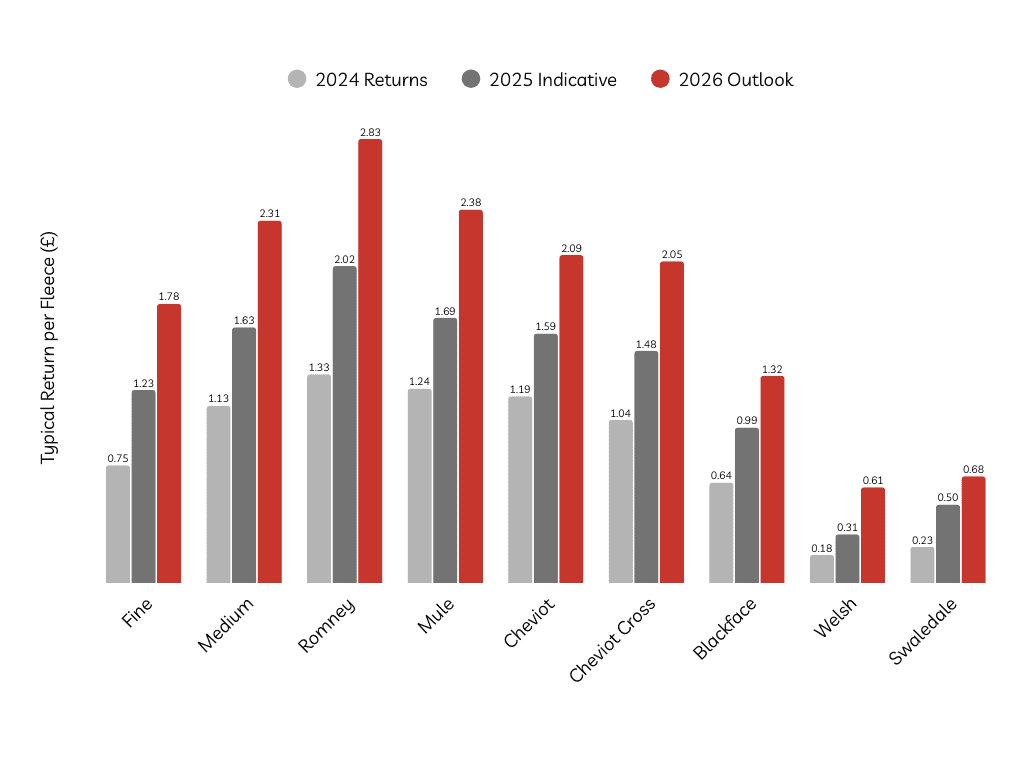
Season-to-date our average selling prices (illustrated in Red on the chart below) are up for all core types, generally by around 15p to 20p per kg. This equates to around 40p more to members for every fleece. Latest prices are even higher (illustrated in Green on the chart below). If these prices are maintained over the last few sales of the season, average prices will continue to rise.
The higher current prices also provide a positive outlook for our members as we head into the 2026 season. Latest prices are as much as 40p to 50p per kilo higher than in the 2024 season. Which would see member returns next year increase by around £1 per fleece.
Supporting Members and Driving Demand
Andrew continued: “Our work to build brand awareness on behalf of our members is also supporting the market for British wool. Consumer research shows that our brand awareness is improving. We now have over 170 brands on our licensee scheme and specifying British wool in their products. Sales of traceable wool at a premium to the commodity market have also seen good growth over the last twelve months.
“With the market showing clear signs of improvement and higher returns this year, I encourage all members to deliver their wool. Handling more wool improves our efficiency, and allows us to invest more in driving demand from manufacturers and consumers to support member returns.”