Meet our Chairman from 1999-2011
Continuing our celebration of 75 years of British Wool. Graze recently met with Frank Langrish FRAgS, who was Chairman for 12 years between 1999 and 2011.
Tell us about yourself:
I am a partner in a family farm running around 4,000 Romney ewes and over 400 cattle. The sheep and cattle run on a low-input lowland grazing system, with the sheep predominately Romney or Romney crosses. The cattle are a suckler herd of pedigree Sussex cattle and purchased in Stores.
I had a lifelong interest in wool, as I am old enough to remember when half of our income came from it. Taking wool into the local “A” merchant or grading depot was a very important day, and my interest was probably deepened by receiving a ten-shilling note from Mr.Strouts, who ran Gregory and Prentis in Ashford when I was six years old.
I learnt to shear on an early British Wool training course at 16. When I was 18, headed off to the Southern Hemisphere and worked shearing, crutching and as a Rousie in the wool sheds. I went on to become a contract shearer in the south east and used to compete in competitions, becoming a Senior shearer in the English team.
When did you join British Wool?
I joined the regional committee which covered all Southern England and eventually became the Chairman of the committee. I became a Board Member in the mid 90’s. Then Chairman of British Wool in 1999 until 2011.
I am probably one of the few people who have seen the various offices and depots. The administrative HQ was originally in London but moved to the Depot at Clayton in Bradford. This site was too small and was eventually sold for housing. The head offices moved to the Euroway Trading Estate to the south of Bradford. The depot was on a separate site a short distance away. In around 2008, the site on Canal Road became available, and everything moved to where it is today in 2012.
During my time as Chairman, I made sure I visited all the depots and met the staff who did such a great job. It was inevitable, as the sheep numbers and weight of wool declined, that depots and staff numbers reduced and sadly have continued to do so.
What were some on the improvements and projects you worked on during your time as Chairman?
Several improvements were introduced. Including the first fully hydraulic packing machines, which were produced by Marsh Engineering, a company located on Romney Marsh. This company had previously manufactured presses for the hop industry.
I also found a way of compacting wool sheets so these could be transported better between collection points and depots.
The most significant improvement in my time was the electronic online auction system. Which was the first in the world. While there was scepticism from the buyers, it has now been well received. It did have a false start in that it was to go live in spring 2001 but FMD stopped that. It wasn’t until 2013 that it began. This revolutionised how wool was sold. Making stock control and invoicing a seamless operation. In the days of the open cry auction, every depot would send in wool samples to Bradford for the buyers to inspect. The costs of this were getting close to a million pounds a year. So, we decided on a wool testing operation, and now have WTAE in Caernarfon. Which analyses all the core samples from the bales, so the buyers have the technical info.
What were the biggest challenges during your period as Chairman?
My biggest challenge as Chairman was the reopening of export markets after FMD, especially China. This entailed visits to Shanghai and long discussions on how we could make the wool and the health certificates acceptable.
As we celebrate 75 years, how important is British Wool and the collective marketing of wool in the UK?
I was, for a short time, the President of the European Wool Group, and it was clear that without an organisation such as British Wool, there was no hope of wool values ever increasing. The organisation is the envy of Europe, with only Norway having an organised collection system now.
If British Wool ceased to exist, there would not be outlets for much of the wool and no one to help promote this excellent fibre.

We held over 130 two-day shearing courses this summer. Which were attended by over 800 all benefiting from learning a new skill or developing their technique and knowledge. Supporting the next generation and shearers is an important part of British Wool’s role. It’s encouraging to see the quality of shearing we have here in the UK, on our farms, but also on the competition stage.
Below, we’d like to share feedback from Colin Jones, who attended a recent course:
“Firstly, I would like to thank you for arranging for me to attend the shearing course at Hurstley Court. I just wanted to let you know that the instructors were amazing and really helpful. They were clearly very knowledgeable, and it was clear that they have a passion to train others in the art of shearing. They structured the two days perfectly which meant we were all able to pace ourselves. They added in a section about how to sharpen cutters and combs plus a couple of reflective practice demonstrations to remind us of what to do and when.”
Several in-shed training days were also held where an instructor works with shearers for a day at their place of work. We’ve received feedback from many who found these days particularly beneficial.
In July, August, and September, we had shearing courses available for anyone wishing to shear lambs or ewes. Including wool handling and support anyone wishing to travel abroad this winter. There are several courses available online, and once again, we can provide in-shed days for lamb shearing.
Also, if you are thinking of traveling this winter, our instructors are available to visit you or a group, providing advice and shearing knowledge.
Richard Schofield, Shearing Manager, British Wool, said:
“The organising of the courses is very much a team effort, and I thank our UK instructors for all their hard work and commitment in supporting the next generation and our shearers.”
To find out more about upcoming courses, visit Shearing Courses
Lamb Shearing Masterclasses
We will be running master class lamb shearing courses in August with guest instructor Justin Bell from New Zealand and Matt Smith.
These courses will be on Romney lambs and a great opportunity to improve your lamb shearing and gear selection. These courses will be covering the whole of the UK.
For more information, click (visit Shearing Courses ) or contact 01274 688666 or email [email protected]
Huw Jones Sets New 8-Hour Solo British Record
On Saturday, 5th July, all eyes were on Machynlleth in Mid Wales. Where Huw Jones, a 27-year-old Welsh shearer, was successful in his shearing record attempt. Achieving a new 8-Hour Solo Ewe British Record, shearing 663 ewes. This beat the previous record held by Martin Howlett of 539.
After months of preparation, the record attempt started at 7am and concluded at 5pm with hundreds of well-wishers in attendance to support and congratulate Huw.
At the end of the record, a tired but delighted Huw said:
“Today has been an amazing day, thank you to everyone who has helped me achieve what I have here today. There are too many people to name individually, but you all know who you are. Records are not just about the shearers attempt but very much a team effort. I could not have achieved this today without so many people. I thank you so much for the support you have given me.”
Huw continued by mentioning the support of his family:
“My family has always supported me to get me where I am today, no matter what I wanted to do, my family has always been there, and I thank them, it means so much. I’d like to mention my grandad, who is sadly no longer with us, but hopefully looking down on me today, he was the one who started me shearing.”
The charities supported by the record, the Welsh Air Ambulance & Aberdyfi Search and Rescue.
Gethin Lewis and Llyr Evans Break Two-Stand Record
A week later, on the hottest day in Wales this year. Gethin Lewis from Rhayader and Llyr Evans from Aberystwyth were successful in their shearing challenge. Achieving a new 8-Hour Two-stand British Ewe Shearing Record. Gethin was also successful in setting a new British Individual Record.
Shearing started at 7am at Gethin’s family farm in Cwmdauddwr, Rhayader, and after four shearing runs, the last ewe was shorn at 5pm, with a combined total of 1,364 ewes shorn in 8 hours. The existing record was 1,075 ewes held by Martin Howlett and Jonny Roberts since 2019.
Both shearers were also up for the 8-Hour Solo Ewe British Record of 663 ewes held by Huw Jones from the previous week. Llyr shore 668 and Gethin became the new record holder, shearing 696 ewes.
Catching up with both shearers at the end of their successful attempt, Gethin said:
“I’m delighted that our attempt was successful. It’s been a 12-month journey preparing for today, but all the hard work has been worth it.”
Llyr agreed and said:
“All roads led to today, and I’m proud of what we have both achieved – it feels great to be a British Shearing Record Holder.”
Speaking about the hot weather, Llyr added:
“ The extreme heat made the challenge more difficult and at times during the day it was extremely difficult, and we both needed to dig deep to get through to the end.”
Both Gethin and Llyr wanted to pay tribute to all those who had supported their attempt, speaking on behalf of both, Gethin said:
“This record would not have been possible without the help and support of both our families. Thank you, it means so much to us both that we have achieved what we have here today. We’d also like to pay tribute to the support and commitment of so many people, too many to name individually. From the farmers supplying the sheep, pen men that were here with us all day, the wool wrappers, and all our family and friends – a huge thank you.”
The Welsh Air Ambulance and Brain Tumour Research were the nominated charities.
More information is available at
https://www.justgiving.com/crowdfunding/gethllyrbritishrecordattempt
Congratulations from British Wool
Gareth Jones, Head of Member Engagement said:
“On behalf of British Wool, we congratulate Huw, Gethin, and Llyr on their incredible achievements. Setting a Shearing Record requires not only personal dedication and skill, but we also appreciate the hard work that goes on behind the scenes, and therefore we offer congratulations to everyone who has helped and supported Huw, Gethin, and Llyr with their Shearing Records.”
A special mention to Alun Lloyd Jones who shorn 725 ewes in 9 hours on 4th July, raising funds for Eif’s Ewing Sarcoma Research Fund.
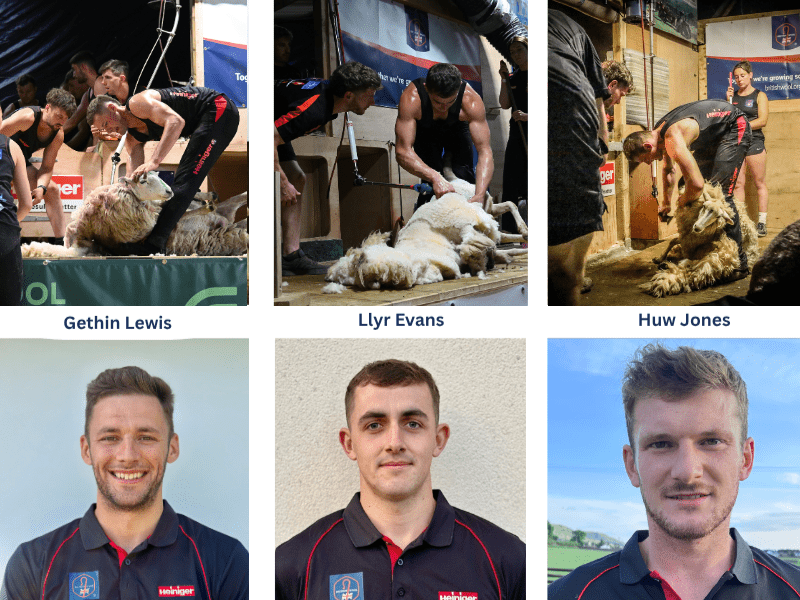
All eyes of the shearing community will be on Wales in early July as four Welsh shearers attempt three British Shearing Records.
Huw Jones, a 27-year-old Welsh shearer Abergynolwyn in Mid Wales will attempt the 8-Hour Solo Ewe British Record on Saturday 5th July.
Shearing normally starts for Huw at the end of April in England before coming back home to Wales to shear from the end of May. Huw shears with his friend Gwydion and hace shorn together for several years on local farms. The aim is always to finish shearing by the Royal Welsh Show so he can enjoy the show!
In recent years, many shearing records have taken place. Huw comments: “Seeing Matt Smith, Rowland Smith, Gareth Daniel, and Ian Jones achieve their records. Planted a thought in my mind that I would like to do something like that one day, but realised I was years away from it! After waiting patiently, I finally achieved a long-term goal 2 years ago in New Zealand, shearing 554 lambs in 8 hours. But I still wasn’t satisfied. I wanted to do 600. So when I got home, I asked my brother if I could try and do a personal best on his sheep. Thankfully, he agreed, and then on the 12th of July 2023, I shorn 704 ewes in 9 hours. That was the big motivation to attempt a record. I set my goal for about 2 years and chose the record I wanted to attempt to break!”
After 12 months of training and preparation, Gethin Lewis from Rhayader and Llyr Evans from Aberystwyth will be attempting the 8-Hour Two Stand British Ewe Record on Saturday, 12th July.
Both Gethin and Llyr farm at home and have experience of shearing not only in the UK but around the world.
In terms of achievements, both commented:
Gethin: “There are many but winning the Champion Shearer of Wales at the Royal Welsh in 2023 & 2024 and representing Wales for three seasons in New Zealand. Being a part of the first ever Welsh test match team to win on New Zealand soil with Llyr Jones are up there as highlights for me. Others would include winning the Great Yorkshire Show and Llysfasi Shears in 2023. As well as winning the Welsh Lamb Circuit Final in the same year at Cwmdauddwr Shears. I have been a part of the Welsh speed shearing team for two seasons. Winning speed shear test matches in New Zealand and in Australia at the Wagga Wagga Speed Shear in 2024. Since the summer of 2025, I have also been a shearing instructor, which I enjoy.
“One of my biggest personal gains from being within the shearing industry is that I’ve met so many new people who all want to help one another. I’m grateful to have made some lifelong friends and memories in various countries, all with shearing at the forefront.”
Llyr: “I have attended several British Wool shearing courses, which I’d recommend to anyone wishing to learn or develop their shearing skills. Other achievements would include making a few intermediate finals in New Zealand in 2019-20. I have shorn a few tallies in the UK and New Zealand, including 734 in 9 hours, as well as qualified for a few open finals in the UK.
“I feel very fortunate to have shorn with many excellent shearers, meeting lots of good people, and making great friends and memories.”
When we asked about what motivated them to attempt a shearing record they said:
Gethin: “Since being involved with Nick Greaves and Llyr Jones’ 9-hour lamb record in 2022, it inspired me to want to attempt one myself. So, in 2023, we set out a Personal Best/Tally Day to see if I could shear 700 in 9 hours. I managed to shear 737, which motivated me further to try a record attempt with Llyr Evans, who shorn a tally of 734 in 2024.”
Llyr: “I have helped with several records and enjoyed being involved and supporting the attempt. I always enjoy being surrounded by hard-working people, which makes me push myself a bit more to get to their level
The third record will a previous Champion Shearer of Wales winner and Welsh shearing team member Alun Lloyd Jones, from Llangollen, attempting the 9-Hour British Ewe Shearing Record.
When and where………………
Huw Jones record attempt will take place at Hendreseifion Farm, Llanwrin, Machynlleth, Powys, SY20 8QQ.
The record will start at 5 am on Saturday, 5th July 2025.
The Welsh Air Ambulance & Aberdyfi Search and Rescue charities will be supported on the day.
Gethin and Llyr’s record attempt will take place at Glan Elan, Cwmdauddwr, Rhayader, LD6 5HG.
The record will start at 7 am on Saturday, 12th July 2025.
The Welsh Air Ambulance and Brain Tumour Research charities.
Alun Lloyd Jones shearing record will take place at Blaenbwch, Maesmynis, Builth Wells, LD2 3HU.
The record will start at 5am on Friday 4th July.
Eif’s Ewing Sarcoma Research Fund will be supported on the day.
31 Years at British Wool
Gareth Jones, Head of Member Engagement at British Wool, will be a familiar face with many farmers and stakeholders across the UK. This year marks Gareth’s 31st year working for British Wool (across two periods, 1990-2004 and 2008 to present).
As British Wool marks its 75th Anniversary, we meet with Gareth to discuss 31 years at British Wool and 35 years within the agricultural industry.
When did you start with British Wool?
Technically, I started in 1988 with a summer job when I was at college studying a BTEC in Business and Finance. When I finished college, I was asked if I was interested in the Administrator role at the depot in Denbigh, North Wales. I accepted and became employed full-time in 1990. My role was responsible for all depot administration, and the intake and dispatch sections.
What would you say are the biggest changes from then to now?
My waistline would be the first thing!! Back then, everything we did manually. I had no computer or mobile phone, no email, WhatsApp groups, text messages. We handled using a landline and pigeon……………sorry, paper and pen. The office posted letters to members confirming their collection details, etc. All the paperwork from the depot, such as receipts of wool and grading details, we sent to the Welsh Regional Office in Newtown. Where the information we inputted onto the farmer’s account ready for payment.
In terms of the depot, much has changed, such as the packing machines. We used to have the old bank bottom packing machines that were bigger-sized bales and not as heavy as the current bales, which produce smaller and heavier bales. Core testing of wool is key, so buyers at the auction have the confidence to buy the product they need. Back in the early 90s, it was all done manually. Whereas since the late 90s, a machine has been developed.
You had a brief break work at British Wool in 2004 for 4 years. What were you do then during this time?
I was aware of proposals to close the Denbigh depot and had always been quite ambitious. This encouraged me to try something different. I was appointed County Executive Officer for the Farmers Union of Wales in 2004, covering the four North East Wales counties. The role managed the union’s activity across the counties. Including membership, communications, policy, and political engagement. This was a role I thoroughly enjoyed. I learnt so much during my short period with the Union. The opportunity to return to British Wool cam up in 2008. The opportunity was too strong as I was returning to an organisation I’d worked in for 14 years. Firmly believing the important role and principles of British Wool as an organisation representing farmers.
What is your role at British Wool?
The role has evolved over the last 17 years to what it is today. I am very proud to be the Head of Member Engagement and a member of the Senior Leadership Team at British Wool. I’m not sure what the 19-year-old Gareth Jones would have said in 1990. But it has been and continues to be a role and organisation I thoroughly enjoy working for. Along with the Member Engagement team. I am responsible for managing all member-facing activity, including marketing, communications, stakeholder engagement, and customer service.
In 2017, I spent 8 months working as Operational Improvement Manager for the business. Supporting the UK depot network on productivity and identifying improvements across the business.
How have things changed in the last 17 years?
In terms of my role, many things have changed. Such as technology and the various platforms and applications available to support our marketing and communication efforts. The different ways of communicating with members have changed. For example, social media, digital, direct communication via email or text, and various electronic newsletters such as Graze and Shear News. Although traditional communication remains important through the press, face-to-face, and postal. The communication options available to us today make it easier, quicker, and more cost-effective to communicate with our members.
What does the future hold?
I see a bright future for British wool. There is a lot of interest in the fibre our members are producing, and the number of brands wanting to use British wool. Long may this and British Wool continue to be a strong voice and representation for UK sheep farmers.
British Wool and the IWTO
We have been a member of the International Wool Textile Organisation (IWTO) for many years. It is the global authority for standards in the wool textile industry. Since 1930, the IWTO has represented the collected interests of the global wool trade. Members come from all stages of the wool textile pipeline, from farm to retail.
Working with the IWTO is crucial for British Wool. Andrew Hogley, CEO at British Wool, explains:
“A critical part of the IWTO is that it sets the global standards for wool testing that all wool growing nations are subject to. These are the tests that all the lots we sell at auction go through at the Wool Testing Authority Europe (WTAE), in Caernarfon. This gives our buyers third party verification on things such as yield, vegetable matter, micron and colour of the wool.”
The (WTAE) is the only IWTO-accredited laboratory in the Northern Hemisphere, making it a vital hub for independent wool testing. Located in the UK, WTAE carries out rigorous testing on wool from across Europe to ensure it meets international quality standards. British Wool is proud to be WTAE’s largest customer, demonstrating our commitment to traceability, consistency, and high performance. As a result, this partnership helps maintain confidence in wool quality across the supply chain.
Likewise the same trusted testing standards are applied globally – wool from Australia, New Zealand, and South Africa undergoes identical procedures to guarantee fibre quality. WTAE therefore plays a key role in upholding the reputation and reliability of the global wool industry.
Andrew continued: “Another crucial part of IWTO is that it brings the global wool community together.”
“We are all facing the same challenges; falling sheep numbers (and therefore wool volumes), prices below where they need to be and wool being attacked on many fronts on animal welfare and the environment.
“This allows us to go to market with a unified voice, as we always say to our members, we are stronger together, and given wool only makes up 1% of global fibres this is also true in the general wool industry.”
We recently attended the IWTO annual industry conference in Lille. Where our CEO Andrew had the opportunity to speak about some of British Wool’s recent successes and ongoing initiatives. His presentation highlighted the positive impact of our contract grading services, particularly in regions such as the Isle of Man and Southern Ireland. Where this approach is helping to improve wool quality and returns.
Andrew also addressed some of the significant challenges facing European wool growers, especially the difficulties they encounter in getting their wool to market due to logistical and economic barriers.
Andrew concludes: “In the UK around 80% of the wool comes to market with 20% being utilised on farm, whereas in mainland Europe, the opposite is the case.
This is because there is no British Wool alternative in mainland Europe working on behalf of the farmer, European farmers are dependent on private buyers often paying rock bottom prices or even have to pay to get the wool disposed of in some instances. Attending the conference this year, it was very apparent that although we face many challenges in the UK with regards to wool we are in a much stronger position than our European counterparts.”
British Wool 1950-2025
Working on behalf of our members for 75 years
This year marks 75 years since British Wool was established to support UK farmers and promote the industry globally.
Many things will have changed during that time. But the one thing that remains is the support we offer our membership from the organising of shearing courses, a UK network of over 100 collection sites, engaging with consumers on the unique benefits and characteristics of British wool to working with over 170 manufacturers using the fibre.
Originally located in London, we relocated to Bradford, West Yorkshire, in 1967. Which was, and remains, the heart of the textile and wool trade in the UK.
As the interest in wool and British wool grew, in 1972 the Shepherd’s Crook mark was trademarked and launched. The logo to this day reassures consumers of the provenance of wool within a product. Currently, we has over 170 manufacturers as part of the brand licensee scheme.
Shearing Training
Due to a shortage of shearers during the 90s, to support the next generation and ensure the UK maintained its long history and tradition of this vital rural skill. In 1999, we committed to providing shearing courses and a training programme. Over the years, this grew, and this year over 100 courses will take place. We are very proud of the quantity and quality of shearers we have in the UK. We also to have the World Shearing Champion and World Wool Handling Champion, Gwion Lloyd Evans and Rosie Keenan, respectively, based here in the UK.
Wool Auctions
Selling products off the farm by auction is a tried and tested method, with wool no exception. In 2003, a significant change in the selling of wool took place with the first electronic wool auction, replacing the traditional open-cry format. This improved the efficiency of selling wool, and it was 18 years later that our auctions became fully remote and online during the 2020 Covid pandemic.
Campaign for Wool
2010 saw the launch of the Campaign for Wool. A global initiative to promote wool to consumers and launched by HM King Charles III when he was HRH The Prince of Wales. This campaign continues to this day with many wool-producing nations across the world collaborating to promote wool’s versatility and environmental benefits.
Consumers and Traceability
Two key developments in recent years for ourselves includes our online marketplace which was launched in 2021. Which provided consumers with a one-stop shop for authentic British wool products. And in 2022, the our Traceability Scheme was introduced to promote the origin of end products.
Keep an eye out for more on the 75th anniversary over the coming weeks and months. Including a series of Depot Open Days taking place during September and October.
Securing Future of Shearing and Clipping Equipment Specialist and Celebrating Prestigious Royal Recognition
Lister Shearing Equipment Ltd, a globally recognised manufacturer of high-quality shearing and clipping equipment, has successfully completed a management buyout from its American parent company, Wahl. This transaction ensures the long-term future of the business. Keeping it firmly rooted in Gloucestershire while continuing to export its products worldwide.
Led by the existing management team. The buyout marks a significant step forward in the company’s journey, reinforcing its commitment to innovation, and quality products. The move provides Lister with greater autonomy, allowing the company to build on its strong legacy while driving growth and investment in new technologies and product development.
The Executive Team that completed the buyout are:
- Sebastian Goodison – Managing Director
- Martin Booth – Sales Director
- Eva Saldana – Finance Director
- Kryspin Skabek – Operations Director
This exciting new chapter comes at a significant moment for Lister. As the company has recently been awarded a Royal Warrant of Appointment by His Majesty The King for the supply of Animal Care Products. This prestigious honour is a mark of excellence and recognition granted to companies, that have consistently provided high-quality goods or services to the Royal Household over a number of years.
The Royal Warrant not only acknowledges Lister’s outstanding reputation. But also reinforces its commitment to quality, reliability, and heritage within the agricultural and animal care sectors.
“This is an incredibly exciting moment for Lister, our employees, and our customers,” said Sebastian. “By taking ownership of the business, we are securing its future and ensuring that we remain committed to the values and craftsmanship that have defined us for more than 100 years. To receive a Royal Warrant from HM The King at the same time makes this milestone all the more meaningful. It is a testament to the consistent quality and reliability of our products.”
The Lister team is focused on building a sustainable and prosperous future for the business, its employees, and its customers.
“We want to thank Wahl for their stewardship and for enabling us to take this next step in the evolution of Lister,” added Sebastian. “Being honoured with a Royal Warrant is an extraordinary achievement that recognises the hard work and dedication of our entire team. We are energised by the opportunities ahead as we embark on this new chapter.”
Joining the Team
As a way of improving member engagement in key wool producing areas. We have recruited two Field Officers operating part-time over the summer months in the areas of Derbyshire & Staffordshire and Dumfries & Galloway.
The key focus of the roles will be to raise awareness of British Wool within their respective areas. Visiting auction marts, shows, and contacting farmers over the telephone to discuss this year’s wool.
Gareth Jones, Head of Member Engagement, said:
“Engaging with sheep farmers to raise awareness of British Wool activity and also on the improving wool price is key. And we felt that having a visible presence in both these traditional sheep and wool producing areas was important in achieving this.”
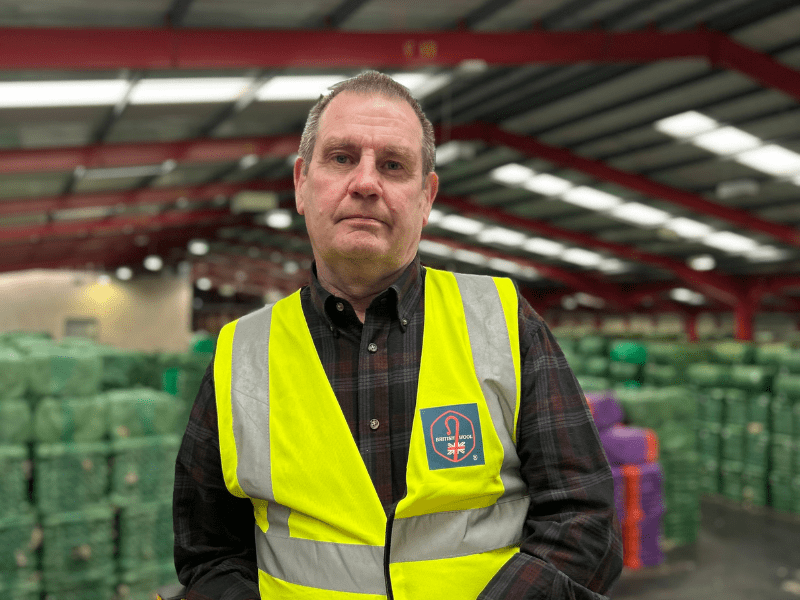
Dave Kowalczyk – Derbyshire & Staffordshire
Expertise in Agriculture and Animal Management
Dave has over 40 years of experience in agriculture. He has owned a small beef herd and managed a flock of over 120 North Country Mules, selling his meat through a retail business. He also has ten years of experience managing fresh food and 27 years in animal feed manufacturing and distribution.
Originally from Staffordshire, Dave holds an HNC in Business Studies from Staffordshire University and a RAMA qualification from Harper Adams University. In his free time, he enjoys hiking and reading, and spends time with his partner and two grown-up children.

Isobel Metcalfe – Dumfries & Galloway
Growing Up With a Love for Wool and Agriculture
Isobel grew up on her family’s farm, which sparked her love for farming. She has her own flock of Rough Fells and has helped at home with her dad, she has also worked in dairy farming. Her family has a long history with British Wool, dating back to her great-grandfather, who sent wool to the company.
Isobel chose to work for British Wool because she believes they prioritise farmers and ensure they receive fair pay. She is excited to represent British Wool and support farmers in her role.
We often hear a common misconception, that we grade wool by breed. In this article, Debunking Wool Grades, we aim to set the record straight and explain how our grading process really works.
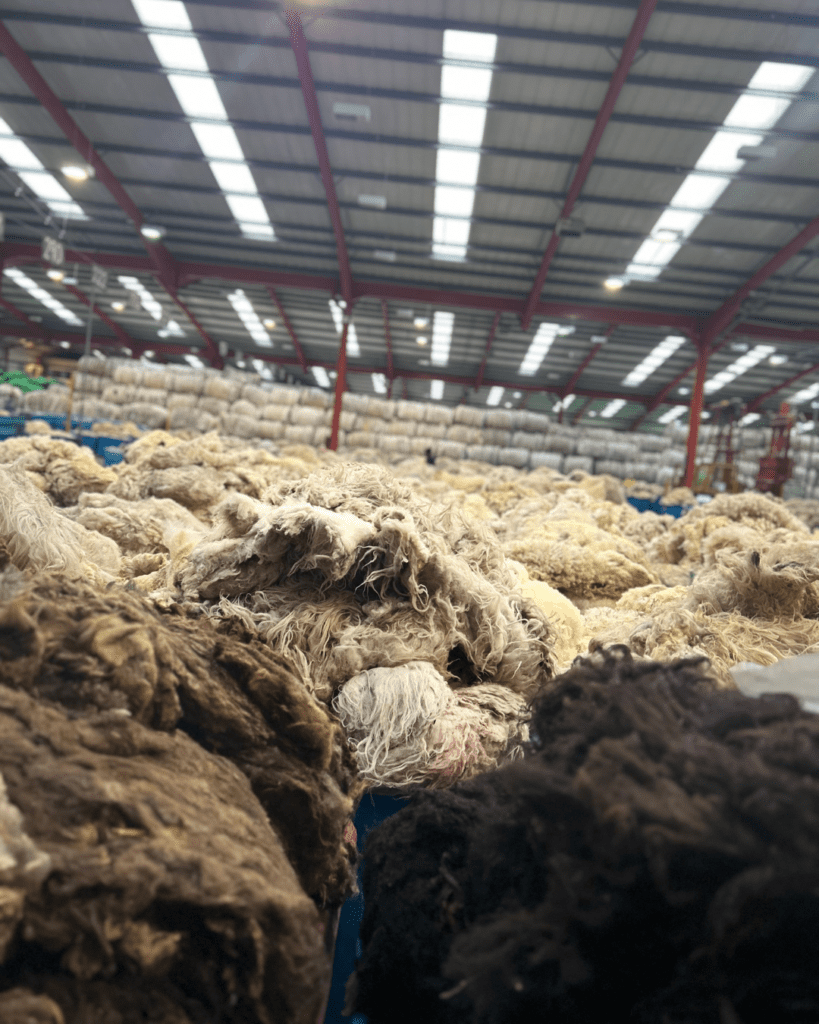
The UK has the most varied wool clip in the world. With over 60 recognised pure breeds and countless crossbreeds. The diversity of our local fleece types stands alone worldwide.
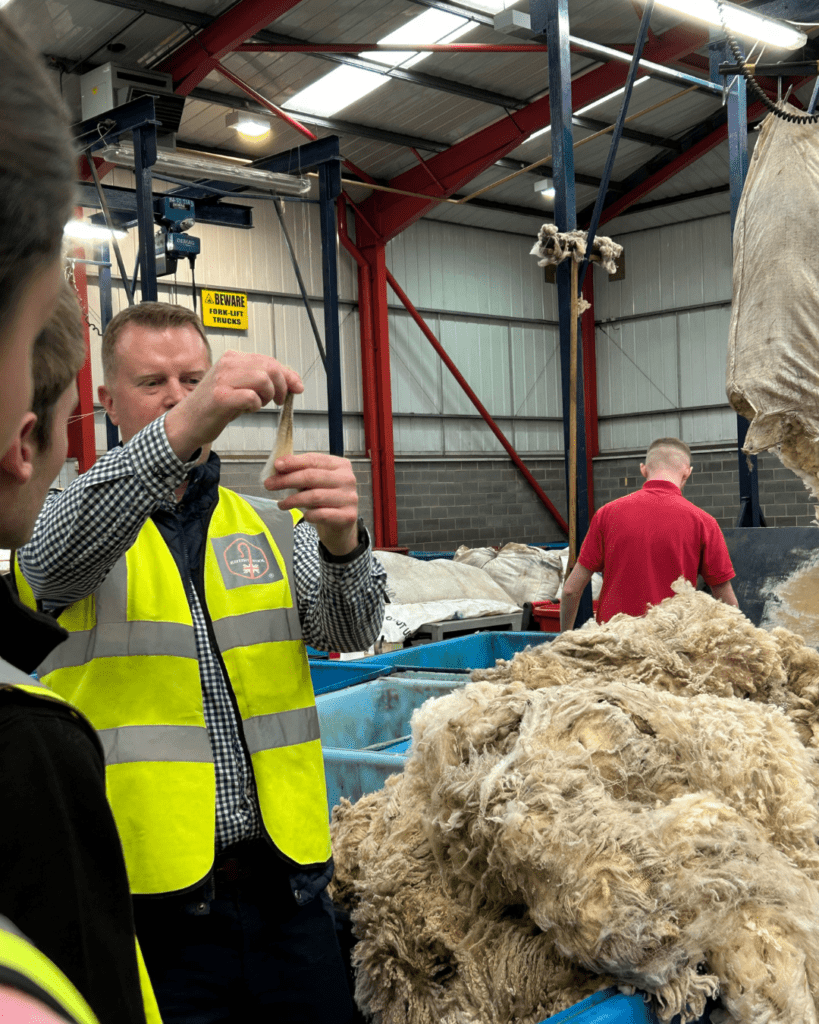
We have a team of 34 full-time wool graders across the UK. Each of whom undergoes a minimum of three years of training, before they are qualify to grade. Every fleece we grade by hand, by individual fleece characteristics such as fineness, length, strength, colour and uniformity. Even within a single flock of the same breed, fleece quality can vary considerably. As a result, an average farmer’s clip in UK can sort into as many as 15 different quality grades.
The Method
This method ensures that every fleece graders asses on its own merit. Helping to maximise its value at auction and giving it the best chance of manufacturers use effectively in the textile industry. Wool merchants and manufacturers rely on British Wool’s grading system to select the precise wool types they need. Whether that’s soft, fine fibres for clothing or more robust wools for carpets and insulation.
It’s also worth noting that manufacturers rarely use a single grade in isolation. Much like baking a cake requires a mix of ingredients, wool processors often blend multiple grades of wool together to achieve the desired characteristics in the final product, such as texture, consistency, and durability.
So, while people may ask, “What breed is your wool from?”, the equally important question is, “What grade is your fleece?”. At British Wool, our expert graders make sure every fleece is handled with care and precision. To support better returns for our farmers and ensuring British wool is recognised for its exceptional quality and versatility.
Watch our Bradford Depot Manager, Ian Brooksbank, perform a grading demo: British Wool – Wool Grading and Selling at Auction